Max is Junior student of high school at Germantown Academy, he also has participated in prestigious educational programs such as:
Harvard Summer School (General Chemistry) – Focused on nanomaterials for biomedical engineering, particularly their role in wearable sensor technology and drug delivery systems.
Stanford Pre-College Program (Psychology) – Researched human cognition and the impact of wearable tech on health behaviors.
Johns Hopkins University Center for Talented Youth (Advanced Computational Science) – Studied AI applications in biomedical engineering, focusing on data modeling and predictive analytics for healthcare solutions.
Max’s Publication
Max Kopp has authored and published research papers on nanomaterials, sensor technology, and their applications. His notable work includes:
Analysis of the Polarized Photoresponse of GeSe and Its Application in Non-Invasive Blood Glucose Monitoring, which earned him a Bronze Medal at the S.-T. Yau High School Science Award (North America Division, 2024)
Max is conducting a groundbreaking project focused on the development of ink-printed flexible sensors for structural defect detection. The project aims to enhance sensor durability, improve ink formulations, and achieve high sensitivity in extreme environments.Research Gate: Flexible nanomaterial sensors for non-invasive health monitoring
Inkjet-Printed Piezoelectric Nanomaterial Arrays for Autonomous Structural Health Monitoring in Spacecraft and Deep-Space Exploration.
This study presents an innovative, deployable inkjet-printed sensor array designed for real-time defect detection in spacecraft. The research focuses on leveraging piezoelectric nanomaterials for in-situ sensor fabrication, achieving sub-1% defect localization error and outperforming commercial ultrasonic sensors by 38% in sensitivity. The technology aims to enhance safety in long-duration space missions by enabling astronauts to fabricate and deploy sensors in microgravity environments.
Max’s Patents
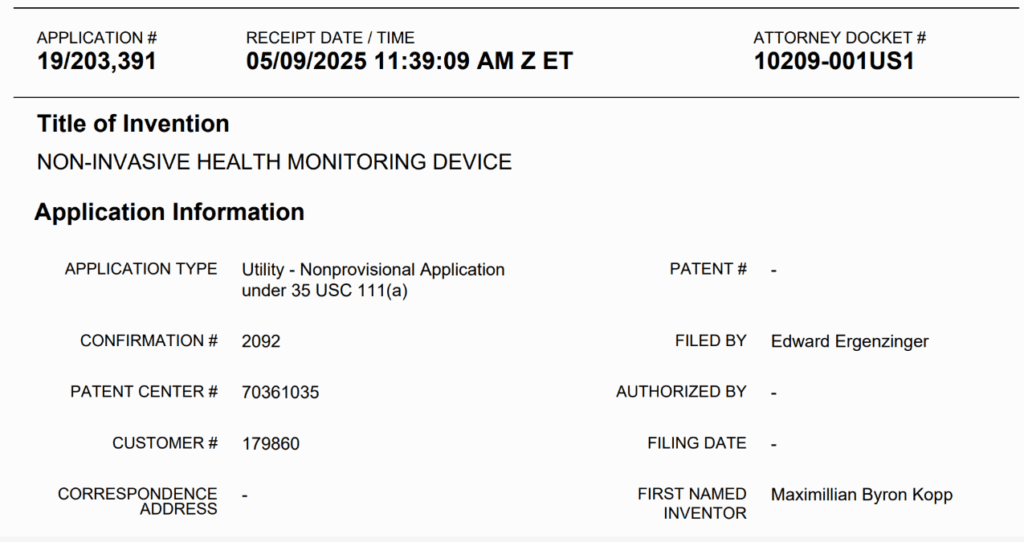
Kopp, M. B. (2025). Non-Invasive Health Monitoring Device Using Polarized Light and Nanomaterial-Based Optical Sensors (U.S. Utility Nonprovisional Patent Application No. 19/203,391). United States Patent and Trademark Office. Filed May 9, 2025. Confirmation No. 2092. Attorney Docket No. 10209-001US1. Application Type: Utility under 35 USC 111(a).
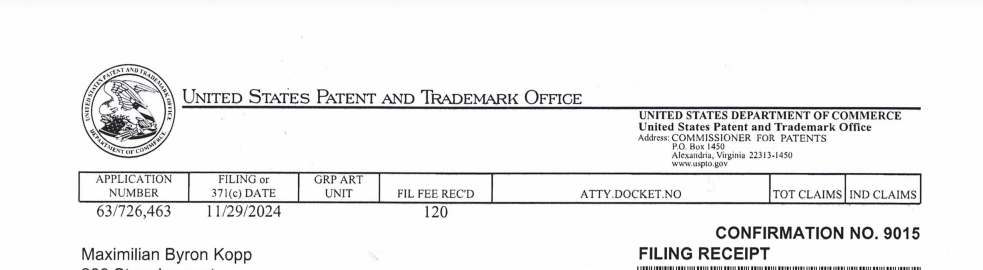
Kopp, M. B. (2024). Non-Invasive Glucose Monitoring System Using Polarized Light and Nanomaterial Sensors (U.S. Provisional Patent Application No. 63/726,463). United States Patent and Trademark Office. Filed November 29, 2024. Confirmation No. 9015.
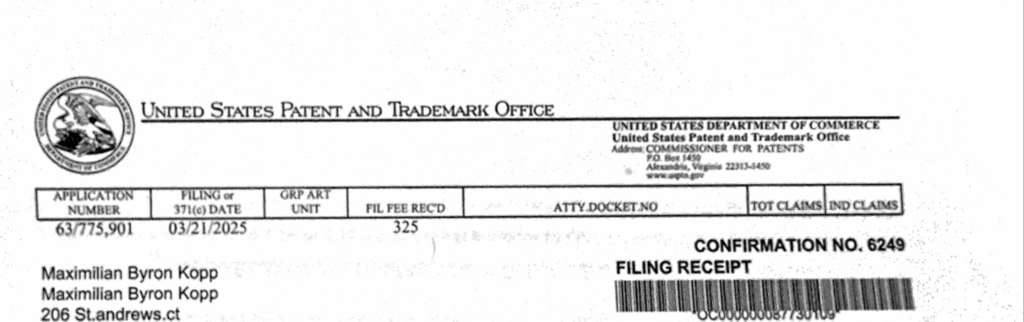
Kopp, M. B. (2025). Real-Time Structural Health Monitoring System for Spacecraft Using Inkjet-Printed Ultrasonic Sensors (U.S. Provisional Patent Application No. 63/775,901). United States Patent and Trademark Office. Filed March 21, 2025. Confirmation No. 6249.